Mastodon

Posts in "hamradio"

Winter Field Day 2026

Winter Field Day is an exciting annual event for amateur radio enthusiasts, taking place on the last full weekend of January. It offers a unique opportunity for radio operators to set up field operations in remote locations, enabling them to connect with other participants worldwide.

Winter Field Day is finally upon us this weekend! It is the perfect time to test your gear in less-than-ideal conditions and sharpen those emergency preparedness skills.

If you are a ham radio operator, I hope you make an effort to get together with other amateurs in your area. Let’s make some real noise on the airwaves.

If you are not a licensed radio operator, you can still go out and share some camaraderie with a local club or even your ham radio neighbor. It is a fantastic way to see what the hobby is all about without the pressure of being on the mic yourself. Lots of groups, like the Everglades Amateur Radio Club, have been getting together for years now to run these events. It is always a fun time with great people, so don’t be shy about stopping by.

#WinterFieldDay #WFD #WFD2026 #HamRadio #AmateurRadio

Experimenting with Video Embedding (Not From YouTube)

I wanted to try embedding some video from a site other than YouTube, so I am trying it out here. The primary goal, therefore, is not the content of the video, but whether I can embed it successfully and have it play reliably.

It is a short video I found from 2023, where I was participating in ARRL’s Field Day event at the local ham radio club. If you are a ham, you can appreciate the video and know how exciting it can get when you are working a pile up. This was probably late into the night, so things are a bit slower and more relaxed. If you are not a ham, and this sort of thing seems interesting to you, go check out your local ham radio club. People in those clubs are generally extremely welcoming and willing to take the time to show you the ropes and teach you a thing or two about communications around the world. It’s great!

Xiegu GPA-100 Amplifier

Xiegu recently introduced the GPA-100 amplifier. I have the previous version of this amp, and it’s great. Yeah, the tuner isn’t wonderful, but I try to use resonant antennas whenever possible. The other thing I didn’t like about it was having to manually change bands. That’s not an issue when you’re just “parking and barking” on a frequency, calling CQ, and working a pileup. On the other hand, if you’re spinning the dial and hunting around for contacts, it becomes tedious.

This new version uses Bluetooth and pairs seamlessly with the Icom IC-705. Every time you change the band on the radio, the amplifier follows automatically. If you’re using CAT control via software like WSJT-X, it sends a command to the radio to change bands or frequencies, and the radio relays that signal to the amplifier via Bluetooth. That feature alone makes this little amplifier worth considering.

So why am I probably not going to buy it? Even though it’s on sale for an “early bird” price of $429, it may not be for me. The amplifier itself is great, but I already have one (albeit the previous version). Also, I want to keep my 705 for QRP work, which I only discovered after I bought that other amp. Turns out I prefer using my Icom IC-7300 in the field when I’m looking for 100W. Otherwise, it’s the 705 for QRP work and portability.

Now, if I didn’t already have another amplifier or an IC-7300, this would definitely be enticing. $400 is still $400, but that’s on the cheaper side of things if you’re at all familiar with ham radio gear. If I were coming into this part of the hobby for the first time, I would definitely buy it and pair it with my IC-705. Anything that makes ham radio easier is good to go in my book. God knows there’s enough difficulty and tinkering going on already.

Temporarily Offline does a great job, showing you how it works with the IC-705 in his video below

One Ham’s Evolution from Frequency Hoarder to Smart Programmer

I was programming another set of Baofeng UV-5R Mini radios I picked up during a “Black Friday” sale on Amazon, and it got me thinking about how I’ve evolved my approach to setting up these handhelds over the years. These aren’t my primary radios, but ones I keep them in our vehicles, toss one into our hurricane preparedness kit, or hand them out to family and friends when we need reliable short-range communication.

For a long time, I used to program my radios based on generic frequency lists I found online or by copying what other operators had stored. Back then, as a new ham, I just wanted to fill every memory channel “just in case” I needed it someday. But after years of experience and countless unused channels, I realized that strategy wasn’t a very good one. So I started streamlining my approach.

First, I looked up all the local repeaters in my area and tested which ones I could actually reach from my most common locations. Then I began adding more purpose-driven frequencies, like those used by SARnet, a network of linked UHF repeaters that spans the state. These are especially valuable before, during, and after emergencies, allowing us to check in across long distances when normal comms might be down.

My programming plan has gone through many iterations and continues to evolve. Things get added, edited, or deleted as our needs change. It’s very much a living system.

Here’s my current strategy for organizing channels on these radios:

Simplex Frequencies
I separate these into two main groups: VHF and UHF. Within each, I include the standard calling frequencies (146.520 MHz on 2 meters and 446.000 MHz on 70cm), the ADVENTURE Frequency for outdoor trips, and any simplex channels regularly used by family and friends.

Local Repeaters
This section includes the repeaters in my immediate area, sorted by how often I use them.

SARnet Repeaters
These are linked UHF repeaters that operate on a statewide microwave network. Most are active and monitored during drills and major events, like hurricanes, floods, etc.

NOAA Weather Frequencies
Most modern radios include weather alert features, but I still manually program the seven standard NOAA frequencies between 162.400 and 162.550 MHz. Having them on standby means I won’t miss critical weather updates, especially during hurricane season.

Fire Department Channels
My local fire department transmits in the clear, so I’ve programmed those frequencies into my radio in receive-only mode. This helps with situational awareness during emergencies — and even during daily commutes.

Local Schools
Some nearby schools also use open radio systems for internal coordination. Monitoring them (again, receive-only) helps me stay aware of drills, closures, or unexpected events that might affect traffic.

If you’re building your own communication plan, two resources stand out: Repeater Book and Radio Reference.

  • RepeaterBook.com is a crowd-sourced, up-to-date database of amateur radio repeaters across the U.S., Canada, and Mexico. It’s great for finding local repeaters, including their frequencies, offsets, and tones.
  • RadioReference.com Perfect for exploring local public service communications — police, fire, EMS, schools, and more. It’s a go-to for situational awareness, though remember: listen only, never transmit.

Both of these, along with a few years under my belt, have helped me create a smarter, more practical setup. Instead of cluttering my radios with unused channels, I now focus on what’s relevant and reliable when it counts.

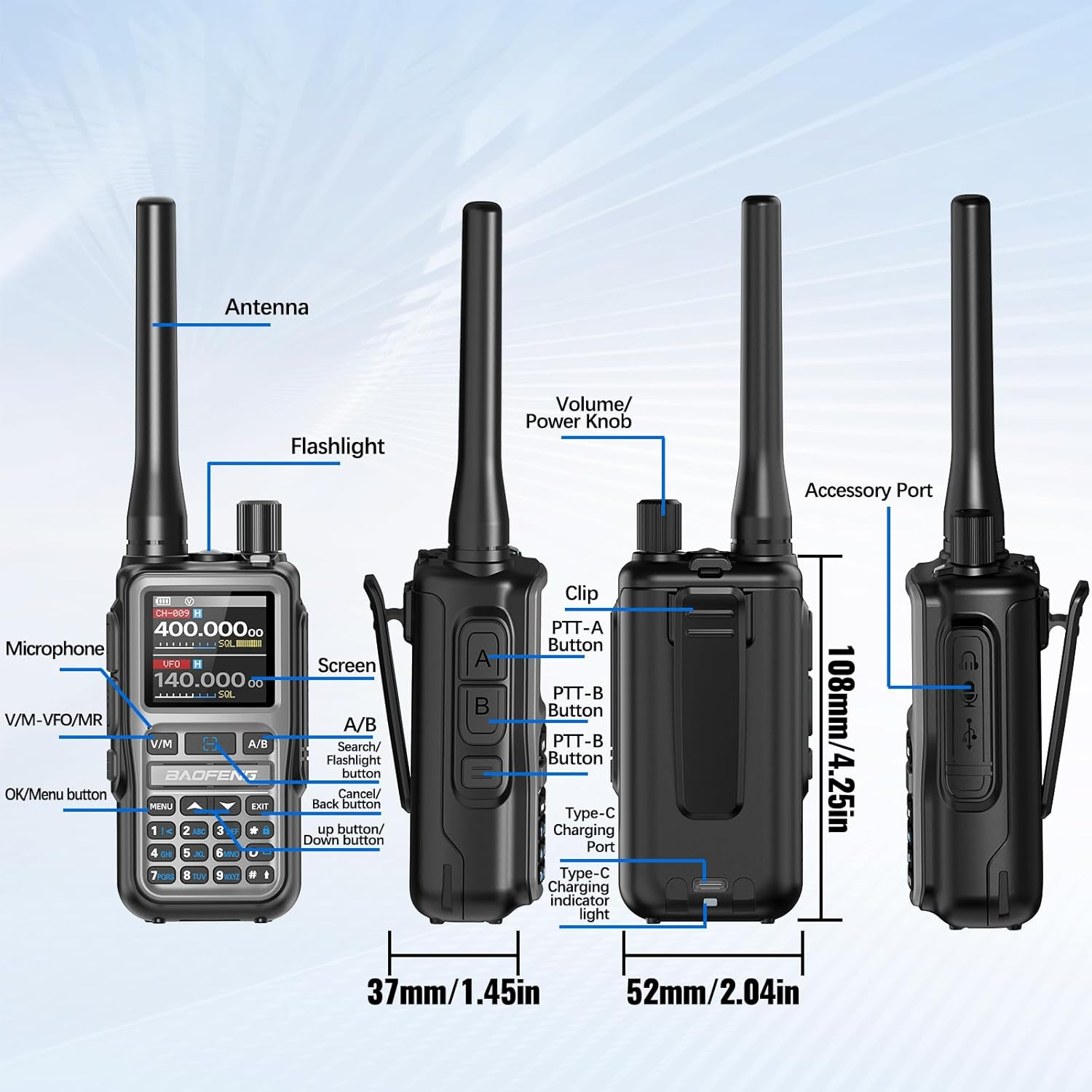
Baofang UV-5R Mini

Every ham is familiar with the brand Baofeng. Most of us probably started with a Baofeng UV-5R as one of our first radios, before moving on to more expensive units. When I got my ham ticket, I wasn’t sure if I was even going to like the hobby, so I bought a $25 Baofeng and used it for a bit while I got comfortable talking on the radio and learning the ropes.

Since then, I’ve moved to more expensive radios from Yaesu, Icom, and Kenwood, but for some reason I always return to the Baofeng for certain situations. For example, when we go out to Field Day, I’d rather have a cheap, inexpensive radio that I can use without risking getting it wet, dropping it, or losing it (like I have in the past). Thank God that was just a Baofeng I lost, not one of the pricier radios.

My latest addition to the Baofeng collection is the Baofang UV-5R Mini ham radio. It’s a simple VHF/UHF dual-band radio that feels solid in the hand despite being very small. It has a built-in broadcast radio, weather channels, the mandatory Baofeng flashlight, and a great-looking little screen. For about $23 each when you buy a pack of two, I think it’s well worth the investment.

I’m going to add it to my stash of inexpensive radios that I can throw in the truck or take with us on family outings, since most of my family are hams themselves. I haven’t tried this yet, but some people say it’s possible to communicate on GMRS frequencies. However, transmitting on GMRS without a GMRS license is illegal (the Baofeng exceeds FRS power limits), though listening is perfectly fine.

For example, monitoring your local fire department for situational awareness is always a ham favorite.

The revamped menu on this radio is pretty good too. I think it’s the display that makes the difference, because the old Baofeng radios were just horrible for me to see. This screen is vibrant and looks really refined compared to older models. Now, the last thing for me to do is try them out and see if they do what they’re supposed to do: transmit and receive. Let’s see how sensitive they are and whether they discriminate against spurious emissions.

Photo courtesy of Amazon.com

National Preparedness Month

National Preparedness Month: 12 Ways to Prepare

Amateur radio serves as a powerful tool and national resource before and When All Else Fails®, but being prepared goes beyond radio.

Great reminder to take time and make sure you and your family are prepared for any kind of emergency, especially this month. A dozen things they mention in the article are

• Sign up for alerts and warnings • Make a plan • Save for a rainy day • Practice emergency drills • Test family communication plan • Safeguard documents • Plan with neighbors • Make your home safer • Know evacuation routes • Assemble or update supplies • Get involved in your community • Document and insure property

Stealth Antennas

New ARRL Book Release: Stealth Antennas for Ham Radio

Stealth Antennas for Ham Radio is full of antennas to get you on the air no matter where you live. Even radio amateurs who live with antenna restrictions or covenant limitations will find solutions in this book.

Home Owner’s Associations (HOA’s) are such a nuisance for Amateur Radio operators (a.k.a. hams), that the Amateur Radio Relay League (ARRL) has produced an entire book to offer options on how to hide your antennas in these restricted communities. I wonder how these people will feel when a natural disaster hits and they rely heavily on the knowledge, expertise and dedication of these hams to bridge communications between them and the authorities in the area or around the world, so they can get the help they may desperately need.

Retavis RT97L Repeater

Our family loves going camping and spending some time outdoors.  Most of the time, our cell phones work pretty well, even if it is just to text each other.  However, sometimes, there is absolutely no signal at all where we go.  This is great because we get to play radio.  Although some of us have a ham radio license, not all of us do.  So, we just switch over to GMRS, which only requires a single license for our entire family.  Most of the time, the GMRS radios work great because we are relatively close to each other while exploring.  However, other times we get on our bikes and wander.  It is during these times that we need a little boost in our comms.  So, an elevated repeater would serve us greatly.    

Jason’s (KM4ACK) video of the Retavis RT97L Repeater really sparked some interest for me.  I will definitely be checking it out.  

Retevis RT97L GMRS Repeater – Key Specs:• Higher power than previous models• Fully GMRS-compatible (462 MHz repeater channels)• Built-in high-isolation duplexer• 12V DC or AC power options• Compact, portable, and IP66-rated case• Lightweight: just under 8 lbs• Plug-and-play with included programming.

Follow Me On Mastodon | Buy Me A Coffee