
Mastodon

Posts in "article"

Retinal Implant

This retina implant lets people with vision loss do a crossword puzzle

Thirty-eight patients in Europe received a PRIMA implant in one eye.

I’m always on the lookout for articles or videos about the latest technology to improve vision loss, suffering from it myself. This particular technology consists of a chip implanted in the human eye, designed to provide vision gain using an external camera mounted on a pair of glasses. It allows someone with peripheral vision but no central vision to make things out.

In this particular study, researchers implanted the chip in 38 different people. On average, participants were able to read five more lines on the eye chart, each line getting progressively smaller.

That’s amazing to me because even seeing one line below my current level would be a Herculean feat. I assume it’s the same for these people suffering from low vision.

It reminds me of Ray Kurzweil’s book The Singularity Is Near, where he argues that the technology we have as humans will one day merge with us to create a superhuman. He continues by saying that eventually, we will lose our humanity and human traits and become all cyborg, if I remember correctly. I don’t like that part, but I do subscribe to the idea of using advanced technology to improve our quality of life, like in this case.

I understand it’s not perfect because it requires a chip implanted in your eye as well as an external camera to help you see. But if you’ve ever met or spoken to someone with a visual impairment, you quickly discover that we already have to use a lot of external technology, and usually, it’s very bulky and extremely expensive because it’s in that vertical market.

I have my hopes set high for this kind of study and these trials. To me, it always seems like this field is stagnant, but that’s only because I want it to speed up and come up with a permanent solution for all people with visual impairments.
1972 Moon Samples

Scientists open untouched Apollo 17 lunar samples from 1972 — they may hold clues about the moon’s violent origins

When the six Apollo missions that landed on the moon returned home, some samples of lunar rocks and regolith they brought with them were stored, pristine and unopened. This is because scientists wanted to preserve them for a later date when more advanced instruments could be used for their analysis.

This is amazing. I can’t even imagine the excitement that these scientists must be feeling to study these samples. It is like going back in time in more ways than one. First, they are taking a short trip back to the Apollo missions of 1972. Then, continuing thousands of years as they make new discoveries of the different chemical signatures they find in each layer of rock sample. I hope that waiting for today’s technology will prove worth it for them.

Pocket Alternatives

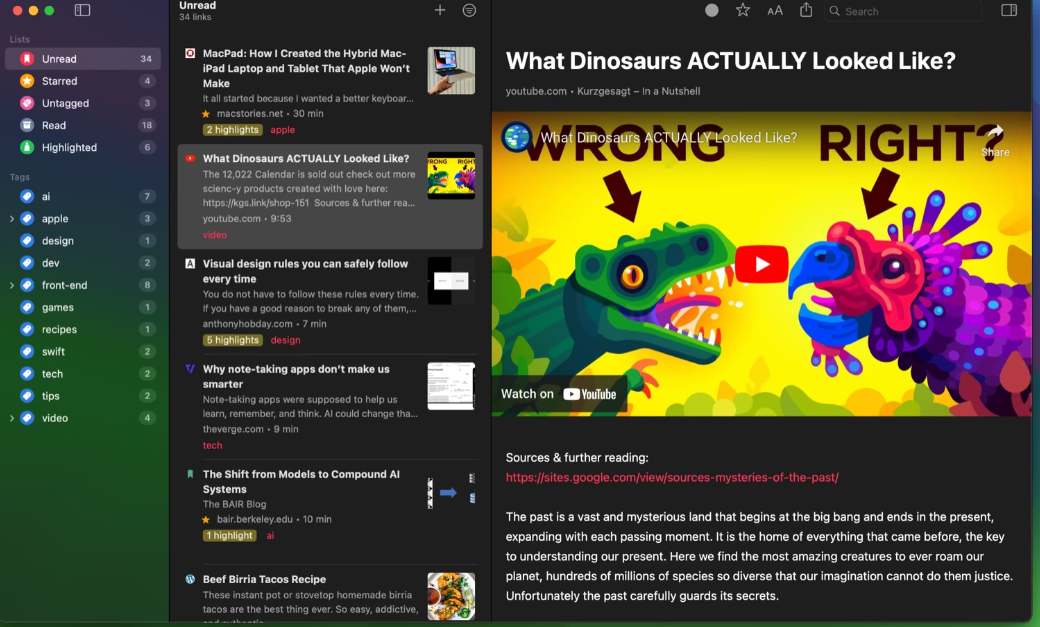
Auto-generated description: A list of highlighted articles is shown on the left, while a colorful illustration of two dinosaurs, accompanied by the text What Dinosaurs ACTUALLY Looked Like? from a YouTube video, is displayed on the right.

Whether you’re looking for a brilliant Pocket substitute or are new to the read-it-later game, these iOS apps will serve your reading needs well.

Now that Pocket, the popular read-it-later service, has shut down, Macworld published a helpful article covering some alternatives. Of all the options they listed, my favorite is by far GoodLinks.

It’s super simple to use. GoodLinks is a universal app that works seamlessly across my iPhone, iPad, and Mac. You don’t even need to create an account to start using it because everything syncs across your devices using iCloud.

The interface is simple and intuitive, keeping the focus squarely on the article itself. The readability is amazing: clear, clean, and just a pleasure to use.

Once I’ve saved articles to read later, I can organize them into different categories. If I decide to keep an article, I can highlight the parts I’m most interested in and add notes. GoodLinks then shows me just the highlights and notes for each article, making it easy to review key information. It’s fantastic.

The app also offers customization options for light mode, dark mode, and even a sepia theme. While I haven’t explored this yet, it also provides Siri shortcuts, which I plan to check out soon.

If you subscribe to certain publications that have a paywall, you can log into those sites through GoodLinks, so you don’t lose access to the premium content you’re already paying for.

I love that it doesn’t require an account. By design, it’s completely private, meaning GoodLinks doesn’t track which articles you’re reading or collect any of the data that other services typically gather.

Finally, my favorite feature is the fully accessible voiceover support. I can load up an article and have it read to me, which is perfect for multitasking. I love this app and highly recommend it.

Life on Mars?

NASA Found Signs of Ancient Alien Life on Mars. Here’s How Excited You Should Be

“The current surface environment of Mars is not hospitable for life as we know it. However, if we do determine that Mars indeed hosted life in the deep past, it would increase the possibility that some form of life has survived to the present day in subsurface habitats.”

While we haven’t discovered life as we know it anywhere else in the universe, recent findings suggest promising signs that life may have existed on Mars. If life emerged once, I believe it can happen again. We surely can’t be the only ones who succeeded in this vast cosmos. I find this absolutely fascinating and eager to read more about it.

Digital Twins

Note: This post was originally published on August 29, 2025. Due to technical issues, it was deleted and I am publishing it again today.

Digital Twins are virtual representations of the physical world—whether that’s a human being, a computer network, or an entire factory. Imagine having a digital twin of yourself that serves as a testbed for various scenarios. For example, if you’re suffering from high blood pressure, instead of trying different medications to see which works best, you could test them on your digital twin first. By feeding it your specific parameters, the system could theoretically narrow down the most effective treatment, since it’s essentially a replica of your own body. With AI integration, it could even suggest customized combinations of medications tailored specifically to your needs.

Another example is computer network management. You’d have your real physical network running in production, alongside a digital twin that’s constantly being experimented on and tested. This allows you to identify vulnerabilities and discover more efficient operational methods without risking your live system. AI-powered digital twins could predict potential attacks and recommend better security measures. At least, that’s the premise and promise.

The same concept applies to customer service. By feeding all the data recorded from real customer service interactions into a digital twin, companies could run countless scenarios to improve service quality. The system might discover ways to achieve better results with shorter phone or chat times per customer, ultimately enhancing both efficiency and customer satisfaction.

Although this is not a new concept, by any means, I think this sounds like a fantastic idea, and I only recently learned about it, which made me want to learn more. What really caught my attention was reading about companies like TwinHealth that are securing tens of millions of dollars in funding and investments, pushing their valuations to numbers with lots of zeros. I’m talking billion-dollar territory. There’s clearly something big happening here.

I know this might sound very “science fiction” of me, but it reminds me of Minority Report, where the “precogs” would predict someone committing a crime and authorities would arrest that person before the crime occurred. What if digital twin technology evolves into something similar? It’s a possibility, though perhaps not a high probability. It’s always wise to consider both the best and worst potential outcomes. Hopefully, we’ll land somewhere in the middle.

Body Farms

Warning! This post may not be suitable for all readers. Reader discretion is advised.

What It’s Like Watching Dozens of Bodies Decompose (for Science)

It sounds like a scene out of a horror film, but these places are real. They’re called taphonomic research facilities, or sometimes “body farms”—sites where forensic scientists study how the human body decomposes. (Don’t worry, the bodies are all donated.) By observing how fast cadavers break down in a controlled setting, investigators can learn more about decomposition and better pinpoint exactly what happened to dead bodies that are found in the real world.

A few years ago, I listened to an audiobook titled Stiff, and it was all about what happens to the human body after death. In this book, I learned about places where donated bodies are placed throughout the grounds of research facilities and exposed to various environmental conditions and the elements. The purpose is for scientists to study decomposition in order to train people in fields like forensics. Until that point, I had never heard of such a thing. Now I see that mainstream publications like Wired are shedding light on the topic. Although it’s morbid to think about, I find the science behind it all interesting.

Follow Me On Mastodon | Buy Me A Coffee