Mastodon

Kagi Privacy Pass

Want your searches to be even more private? Use Kagi Privacy Pass. This feature is available for Professional, Ultimate, Family and Teams subscribers. Read below for a quick overview of it’s features, pros and cons of the feature.

Key Features

  • Token-based authentication system that verifies subscription status without identity disclosure
  • Complete search session isolation - no cross-search tracking or profiling possible
  • Anonymous search capability while maintaining premium Kagi search quality
  • Enhanced privacy layer beyond standard search anonymization

Pros

  • Eliminates all personal data collection during search sessions
  • Prevents behavioral profiling and search pattern analysis
  • Ideal for sensitive research and confidential work
  • Maintains high-quality search results without identity compromise
  • Provides genuine anonymity rather than just privacy settings

Cons

  • Disables personalized search features and customizations
  • Removes access to user-configured bangs and lenses
  • Eliminates tailored search result preferences
  • Requires choosing between personalization and complete anonymity
  • May reduce search efficiency for users who rely on custom settings

Kagi Shortcuts

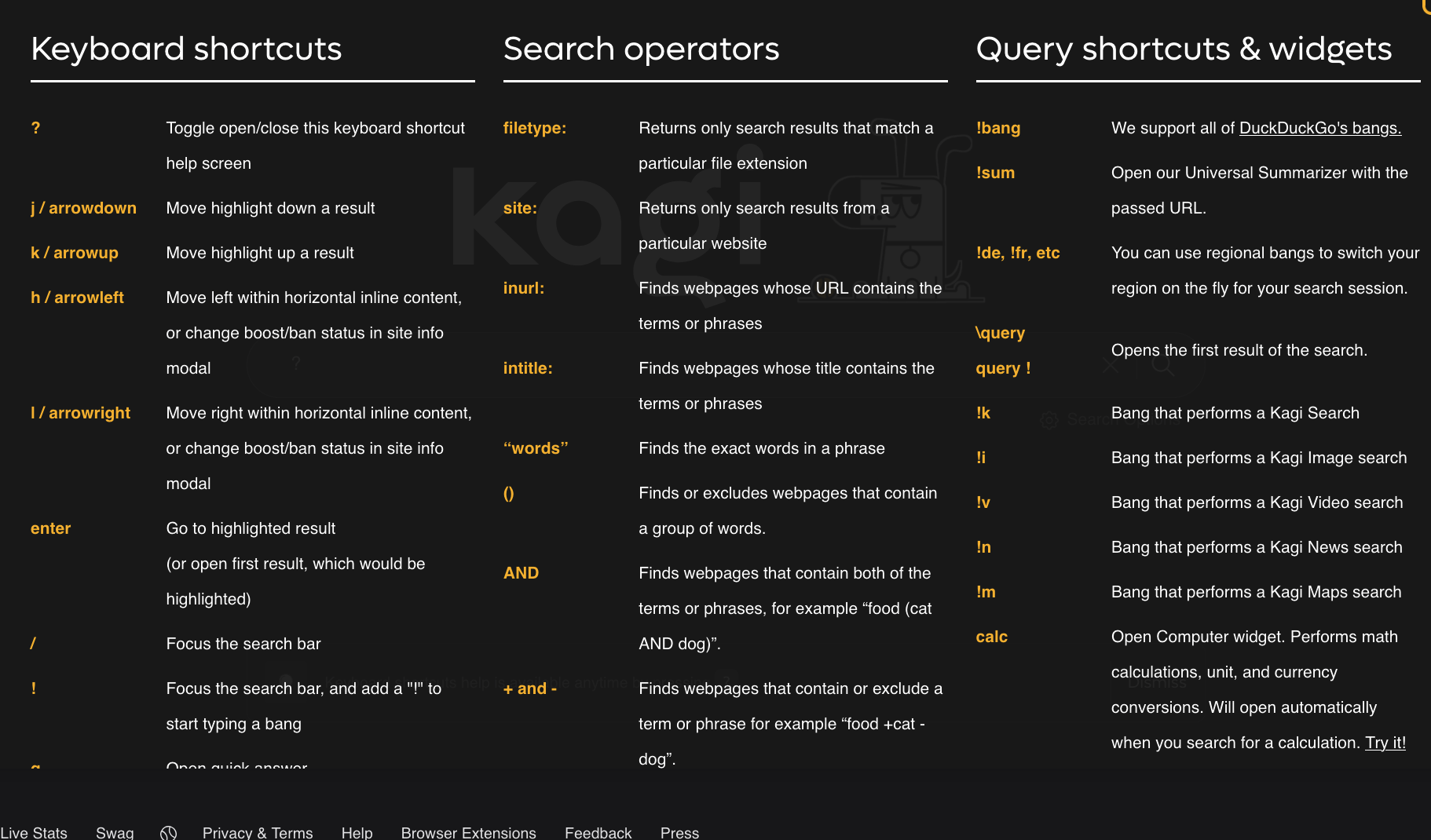
I moved to Kagi as my default search/AI engine a few days ago and I am still finding out new ways to use it better. So much fun! If you are one of those users (like me) that likes to keep their hands on the keyboard instead of moving over to a mouse/trackpad to do things, then check out all of the keyboard shortcuts it offers right on the browser… any desktop browser. Not sure about iOS. I know they have a Kagi app for Android that may have all of these capabilities, but the iOS app is forthcoming.

It does not stop there, either. Check out their Search Operators and Query Shortcuts & Widgets, too. If you want to try it yourself, I recommend starting off with the free 100 search trial to see if it is a good fit for you. Don’t subscribe unless you are really sure it is going to be worthwhile.

Ottis

The “official greeter” at a small vinyl record store in downtown Augusta, Georgia.

A large white dog with distinctive dark spots is lying on a leather couch next to a person.

Privacy Is Not Free (and maybe it shouldn't be?)

Note: This post was originally published on August 10, 2025. Due to technical issues, it was deleted and I am publishing it again today.
We all like free stuff, but maybe we shouldn’t. Like many people, I loved gmail and google search when it first came out and used it for years. Then, a few years ago, I stopped to think about why these great products were free. What’s the catch? Well, I was. I agreed to use their products for free and in exchange, they took my usage history, search queries, and don’t forget cross site tracking, I’m sure. Then, sold it to whomever they chose to after building a nice Doug profile package.

First, I dropped gmail and went to a paid email service and it felt good. Great customer service and lots of features, like rules, folders, easy import from other services, DNS management, etc. Anyway, I switched over to them and couldn’t be happier. I still stuck with GOogle search.

A couple of years after that, I started considering the privacy of my searches. Not that I search for anything nefarious. Mainly things like user manuals, device drivers, reference to making ethernet cables, and other boring stuff. Things that many of us may search for on a regular basis. Either way, it is no one’s business but my own. So, I played around with SearxNG and self-hosted it as well as put it up in the cloud. I tried it both ways, but ended up just preferring it locally. Overall, it was pretty good, but Google and other search engines still seemed to provide more relevant results.

Recently, Google search results have been abysmal for most things I search. They try to make it convenient and give you everything right up front, but I just want links to go to and pick and choose the information I am looking for. It is supposed to be a “search” engine, after all. Not an answer engine, right? If I want quick answers, then I use one of the many AI companies out there or one of the open source local models I have downloaded in LM Studio. This nudged me to go hunting for something better. Something that would give me good results for what I was looking for and had privacy at its core. That turned out to be Kagi for me. Kagi gives me the great search results, control over the results it provides, a beautiful clean interface, and so much more. Not to mention their AI Assistant that lets you choose from a lot of the major models like ChatGPT, Claude, and Mistral, among others. I am new to it, so I am not an expert, but I do know that it is not just hype. They seem to deliver what they promise, so far.

It doesn’t seem like I am the only one that feels like this, either. Check out some others below.

There’s an (oversimplified) axiom that if a good or service (like Google search, for example, or good ol' Facebook) is free for you to use, it’s because you’re the product, not the customer. With Google, you pay with your attention, your behavioral metrics, and the intimate personal details of your wants and hopes and dreams (and the contents of your emails and other electronic communications–Google’s got most of that, too).

audiobookshelf

If you are lucky enough to own all of your audio books in a DRM-Free format, you should really try out audiobookshelf. You will not be disappointed.

If you have already tried it and are using it, chime in and tell us what you think of it, what you like and dislike about it and any tips and best practices for new users.

Voice Cloning

Why AI-based voice cloning is the next frontier in social-engineering attacks.

I’m sure we’ve all heard of phishing scams or, unfortunately, experienced them ourselves. At work, you might even receive “training” emails designed to see if you fall for them by clicking on a malicious link. If you do, the IT department might send you to participate in additional training to avoid these in the future. Just when you thought these were scary or just annoying, something even more dangerous and frightening exists that make these email scams seem quaint.

These come in the form of deep fakes enhanced by AI. Essentially, someone can record as little as three seconds of your voice and then use an AI company like ElevenLabs, or the like, that can turn regular text into speech that sounds just like you, including the little ticks and pauses we all tend to have. Combine this with a frantic-sounding voice on the phone, calling you or someone you love and asking for money or other sorts of private information because they are supposedly having an emergency. At that moment, you may doubt the authenticity of the voice but go along with it anyway because you are scared and unsure if you were just being paranoid. Then, you give them everything they asked for without taking a moment to think whether you should do it or not. This is when they “got” you!

These scammers prey on and count on human emotion and turn it into your Achilles heel. Don’t let them! In the age of AI, you have to question things, trust your instincts a little bit more, and pause just a little longer than usual because even the most grounded people can succumb to a temporary lapse of judgement, especially during a time of weakness like when you are exhausted after a long day of work, lack of sleep, or other life stresses. It can happen to any of us.

Larry Magid wrote about his Voice Cloning nightmare back on May 5, 2023. This is the first I had heard of such a thing and it stopped me cold. Read his blog post.

You can also read the original Ars Technica article that inspired my post, if you want more information.

Apple: The First 50 Years

In time for Apple’s 50th anniversary, “CBS Sunday Morning” correspondent David Pogue tells the iconic company’s entire life story: how it was born, nearly died, was born again under Steve Jobs, and became, under CEO Tim Cook, one of the most valuable companies in the world. The 600-page book features 360 full-color photos, new facts that correct the record and illuminate Apple’s subversive culture, and 150 fresh interviews with the legendary figures who shaped Apple into what it is today.

You know… I’m a fan of history and I’m also a fan of technology, especially Apple products. My favorite, and maybe because it was my first, has always been the “Sunflower” style G4 iMac. It was so beautiful and elegant.

So when I heard that David Pogue was coming out with a book about Apple’s first 50 years, it definitely caught my attention . I did a bit more digging and discovered that it’s going to be a coffee table style book, packed with history and pictures, featuring new interviews with the likes of Woz, and spanning over 600 pages. I figured… “why not?” and pre-ordered it.

It won’t be released until March 2026, which conveniently aligns with Apple’s actual 50th anniversary in April. I have a feeling it will be worth the wait. I’ll have to wait until next year to find out for sure, but I’m optimistic.

If you’re interested, you can check it out at the book’s official site. There, you can pre-order from various places, including Amazon, Target, and bookshop.com, among others.

Follow Me On Mastodon | Buy Me A Coffee