
Mastodon

Posts in "A.I."

How I Vibe Coded My First App

I am lucky to work in a school system that provides lots of materials for me to use with my students. However, sometimes I am left looking for resources that are strategically tailored to meet my students’ needs that day. While I can usually search the web for ideas, I often cannot use them because they are not aligned with our standards, require a purchase, or are simply not that great to begin with.

Having that itch to scratch left me looking for a “backscratcher” I can call my own. So, I started looking into creating something to meet these needs and benefit my students. But where do I find someone who can help me create my own thing that I can use, free of charge (except for the time I dedicate to it) and, more importantly, guide me through the process? I am no programmer by any stretch of the imagination, but here I am wanting to create my own solution that is tailored to what I want. It cannot be a universal, one-size-fits-all kind of deal. No one is going to take the time to hold my hand while I figure this stuff out. Maybe I can’t find someone, but maybe there is something that can do that?

Well, everyone is talking about A.I. lately and how great it is or how horrible it is, depending on their point of view. I am sure the truth lies somewhere in between. Why not give that a try and see if it can help me achieve my goal.

I started my journey by taking what I had learned on the various podcasts I listen to or the books and articles I read daily and delved into Claude Code. I felt like the proverbial blind men feeling the different parts of an elephant and describing it to each other.

I virtually knew nothing about it. I knew that it was a product by Anthropic and that it was AI. However, I had no idea how to use it, let alone what it was capable of.

I started by reading everything I could about it. Then, I learned how to install it on my Mac via the terminal. I tried it, but it stopped me right away because I did not have a paid Claude account. That was my first stumbling block. I had to go in and sign up for the Claude Pro plan. Once I continued the process, it asked me to log in. I did that, and it was pretty easy. So far, so good.

Now that I had it installed, I ran it by typing “claude” in my terminal. It greeted me with more questions on permissions, folder locations, and so forth. I followed the on-screen prompts, and somehow, I got to a blank terminal window with Claude welcoming me. It asked me to create a folder for the project I wanted to work on. I had no idea what to work on, so I tried several things before landing on the one that I wanted… no, the one that I needed to work on.

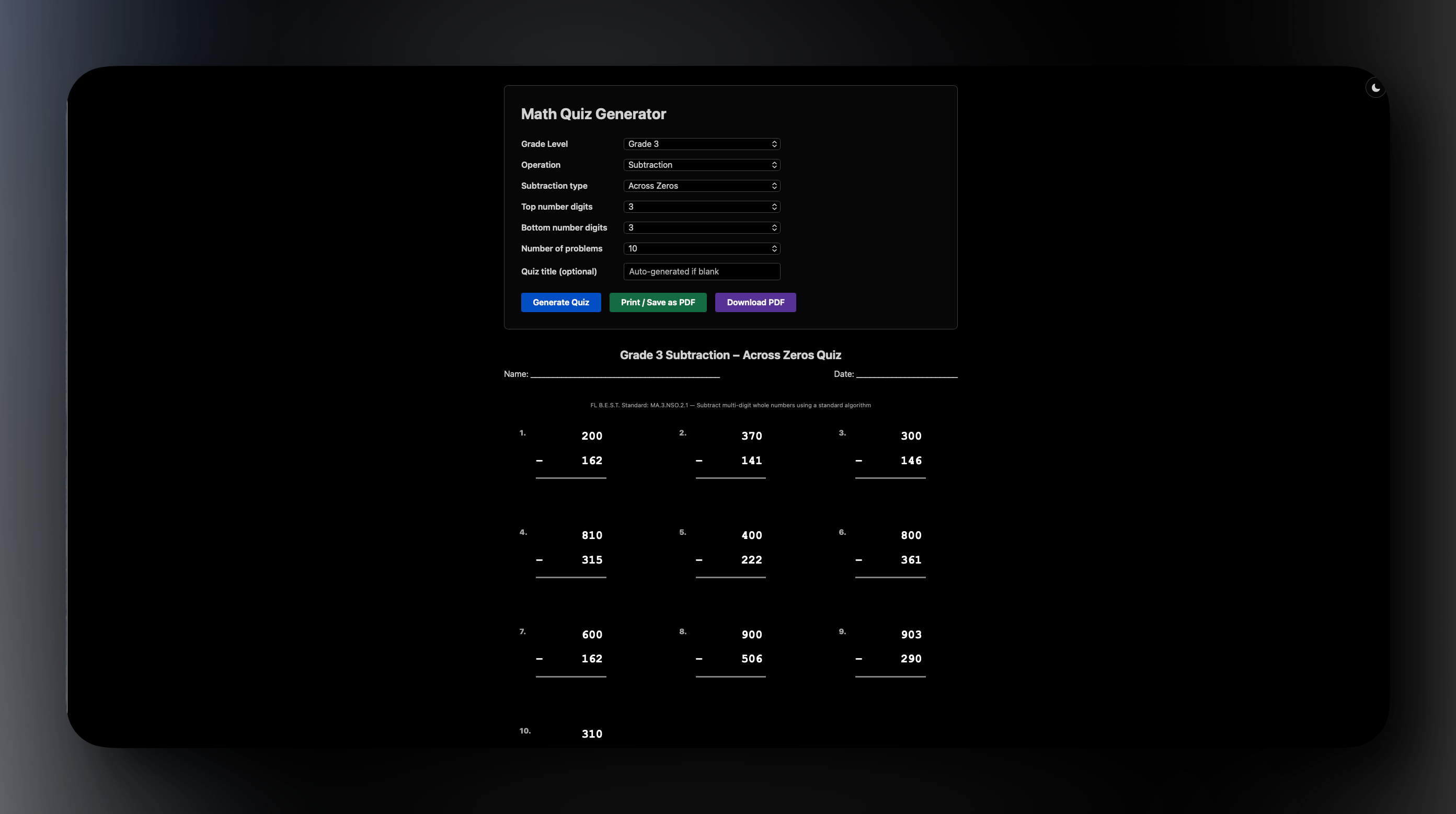
Remember that I wanted to find something tailored to my students? Well, in this particular case, I needed something that would provide them with more practice subtracting three digits from three digits, specifically across zeros. For example, **600 - 256 = ? ** and the like. Consequently, I started telling Claude what I wanted in plain English, trying to be as specific as possible so it gave me what I wanted, not just what it thought I needed.

After going back and forth for a bit (ok, ok… a few hours), I narrowed it down to making a Math Quiz Generator that teachers, parents, and even students could use for practice math problems. I didn’t just include subtraction problems because I figured making all four basic operations available would be beneficial to my students and whoever else wanted to give it a try.

Long story short(er), I ended up “vibe coding” my first app. It serves a legitimate purpose, aligns with our educational standards, is easy to use, shows various kinds of math problems on screen, and can print or save them as a PDF. Since my goal was to try and make something for my students, the whole thing is made free for them to use on the web. The only cost was the $20 I had to pay for Claude Pro.

Come to think of it, it is probably going to cost a lot more because now I want to make more things for them to use and help them succeed by practicing what they need.

I am pretty excited about the possibilities now that I have seen what I can make with the help of AI. I still don’t come close to considering myself a programmer any more than I consider myself an author because I can write a blog post. However, if more people can harness the power of these tools to make better, customized tools for their benefit or the benefit of others, then I think we are in good shape. The future looks brighter than what some people make it out to be.

#Education #EdTech #AI #ArtificialIntelligence #VibeCoding #Math #App

Empire of AI by Karen Hao

just finished listening to the audiobook “Empire of AI” by Karen Hao (wrapped it up on December 30, 2025), and I have to tell you, if you still think OpenAI is just a bunch of benevolent geniuses trying to save the world, you need to grab this book. Although the book focuses on OpenAI, this can probably be subsituted by any of the other major AI companies out there today.

Hao’s central metaphor is absolutely spot-on. She argues that OpenAI operates exactly like the old empires of history. It plunders resources (our data), exploits cheap labor from around the world, and drains natural resources from vulnerable countries, all to centralize power and wealth for a few chosen ones in Silicon Valley.

What really struck me was how quickly their mission took a U-turn. Remember when OpenAI started as a non-profit designed to fight the “evil” of Google’s DeepMind and protect humanity? Yeah, well, that didn’t last. As soon as Sam Altman and the leadership realized that compute costs billions, the “open” part of the name turned into a lie. They took a $10 billion investment from Microsoft, locked down their research, and basically morphed into the very thing they promised to destroy.

Then you have the “heroes” of the story, who come off as deeply flawed. Sam Altman doesn’t seem like a tech visionary here so much as a “steezy” politician and salesman. He apparently has a Napoleon complex (literally admiring the, self-proclaimed, emperor) and comes across as manipulative. The story of him getting fired by his own board via Google Meet while he was watching F1 in Vegas is something movies are made of. Then there’s Greg Brockman, a workaholic who treats the company like a cult. He just wants to be remembered at any cost. And Ilya Sutskever? He’s the “cerebral” genius who drank his own Kool-Aid with the mantra “Feel the AGI,” only to realize way too late that safety had taken a backseat to profit.

But honestly, the darkest part of the book is about how the “magic” is made. It is built on human suffering. Hao exposes how OpenAI outsourced the horrific job of filtering toxic content like violence and CSAM to workers in Kenya via a company called Sama. These people were left with severe PTSD. They also exploited desperate, highly educated Venezuelan workers for data annotation, paying them pennies.

It isn’t just human exploitation either. It’s environmental. In the race for compute power, they (along with Microsoft since OpenAI are using Azure services) are draining water in drought-stricken places like Chile and Uruguay just to cool their massive data centers. It is classic imperialism. They extract value from the weak to empower the strong.

The book ends with a warning that really stuck out. The only way to stop this empire is to decentralize it. We need to stop handing over our data and start supporting independent, transparent research. We can’t underestimate the power of the people, but as I noted while reading, we need to get off our asses and actually do something about it. If you care about privacy, labor rights, or just want to know who is pulling the strings behind the curtain, you should pick this one up for sure.


#Books #KarenHao #EmpireOfAI #OpenAI

The End of "Seeing Is Believing"

Deepfake Videos Are More Realistic Than Ever. Here’s How to Spot if a Video Is Real or AI

Remember when “fake” on the internet meant a badly Photoshopped picture? Ah, simpler times. Now, we’re all swimming in a sea of AI-generated videos and deepfakes, from bogus celebrity videos to false disaster broadcasts, and it’s getting almost impossible to know what’s real.

Not too long ago, whenever you saw a photo or video, it was safe to assume it was real. Sure, you probably knew it had been touched up a bit or cropped for emphasis, but overall, you could believe what you were seeing. Then you started scrutinizing photos more carefully when composites became common, and even more so when Photoshop made it possible to remove or insert objects and people who weren’t in the original image. The only comfort we had was that these skills were limited to a select few. Otherwise, it was easy to spot the imperfections that gave away a fake.

Then came videos. When watching a movie, we assumed most of it was enhanced or outright faked, and we called it movie magic. We knew the context and situation we were putting ourselves into, so we expected it and allowed ourselves to be fooled for enjoyment and entertainment.

Somewhere down the road, AI-generated videos started appearing. The most popular one was probably the Will Smith eating spaghetti video from 2023. It was clearly fake and easy to spot because of its low quality and uncanny valley appearance. Other videos were easy to identify because AI struggled with rendering hands. They always looked weird, sometimes with six fingers, which was a dead giveaway.

Since then, AI has gotten significantly better at creating images and videos. You can still spot them, but it’s much harder now.

This CNET article linked above offers some suggestions for spotting fake AI-created images and videos. Basically, trust your gut. If something looks too perfect or oddly off, it’s probably fake. Another suggestion is to run it through a metadata checker, where responsible companies will indicate if content was AI-generated. However, they acknowledge that most people won’t take that extra step. Looking for watermarks from companies like Sora or Google can also help identify AI content. The problem is you’re depending on creators to insert those watermarks. Usually, those aren’t the ones you need to worry about since they’re mainly for entertainment.

The real danger comes from content designed to convince you of something fake by passing it off as real. Those are the ones you need to scrutinize carefully and make your own judgment about whether what you’re seeing is true. Check your sources and verify information through other means to confirm what’s being portrayed is actually real. Don’t take things for granted, and please educate others. I’m thinking especially of older generations who may not be up to speed on these capabilities and could be easily fooled. I’m not saying they’re less intelligent than us because any of us can be fooled by this at any time. Let’s continue to look out for one another.

AI in the CLI

Okay, this one is definitely for us nerdy types out there. We’ve all used some kind of AI service in the past, like OpenAI’s ChatGPT, Anthropic’s Claude, Google’s Gemini, or maybe even Microsoft’s Copilot. We use these guys on the web, but have you ever used them locally via your command line?

In this NetworkChuck video, he shows us how to use AI directly in the command line. He argues that it’s much faster and allows you to do things like keep the context of your chats locally in a folder and file structure.

Gemini CLI, for example, is free and in his video, he shows you how to install it and walks through the process. It can access files, run scripts, and allows you to have context management right from your terminal. But he doesn’t stop there.

He goes on to tell you about the awesomeness of Claude Code. This version of the AI service uses Anthropic’s Claude and does pretty much everything Gemini does, but it’s a little more versatile because it uses agents.

Agents are basically specialized versions of AI that you create. First, you create the agent by giving it the parameters and characteristics you want it to have. Then, you have it only answer questions it is an expert at. For example, you can designate one as an expert at networking, and then have that agent help you design the best home lab. While another agent that you designed to be a travel agent can focus on creating an itenirary for your weekend trip to New York.

He then kicks it up a notch and shows you how to put all these agents together to work collaboratively, finding the most thorough responses for you. It is a very powerful tool.

If you’re into experimenting and trying new things, especially on the command line, I would definitely give this video a look. He goes through it pretty quickly, but you can pause and examine things more closely, then do your own research to get the specifics down before trying it yourself.

I would caution you that these AI tools ask for a lot of permissions to access things on your computer and on the web, and you do have to give explicit permissions, which is a good thing. Although he shows you how to get around these safety nets, I would think carefully about doing so and know that you’re running it at your own risk at that point.

Just be careful and have fun.

Digital Twins

Note: This post was originally published on August 29, 2025. Due to technical issues, it was deleted and I am publishing it again today.

Digital Twins are virtual representations of the physical world—whether that’s a human being, a computer network, or an entire factory. Imagine having a digital twin of yourself that serves as a testbed for various scenarios. For example, if you’re suffering from high blood pressure, instead of trying different medications to see which works best, you could test them on your digital twin first. By feeding it your specific parameters, the system could theoretically narrow down the most effective treatment, since it’s essentially a replica of your own body. With AI integration, it could even suggest customized combinations of medications tailored specifically to your needs.

Another example is computer network management. You’d have your real physical network running in production, alongside a digital twin that’s constantly being experimented on and tested. This allows you to identify vulnerabilities and discover more efficient operational methods without risking your live system. AI-powered digital twins could predict potential attacks and recommend better security measures. At least, that’s the premise and promise.

The same concept applies to customer service. By feeding all the data recorded from real customer service interactions into a digital twin, companies could run countless scenarios to improve service quality. The system might discover ways to achieve better results with shorter phone or chat times per customer, ultimately enhancing both efficiency and customer satisfaction.

Although this is not a new concept, by any means, I think this sounds like a fantastic idea, and I only recently learned about it, which made me want to learn more. What really caught my attention was reading about companies like TwinHealth that are securing tens of millions of dollars in funding and investments, pushing their valuations to numbers with lots of zeros. I’m talking billion-dollar territory. There’s clearly something big happening here.

I know this might sound very “science fiction” of me, but it reminds me of Minority Report, where the “precogs” would predict someone committing a crime and authorities would arrest that person before the crime occurred. What if digital twin technology evolves into something similar? It’s a possibility, though perhaps not a high probability. It’s always wise to consider both the best and worst potential outcomes. Hopefully, we’ll land somewhere in the middle.

Follow Me On Mastodon | Buy Me A Coffee